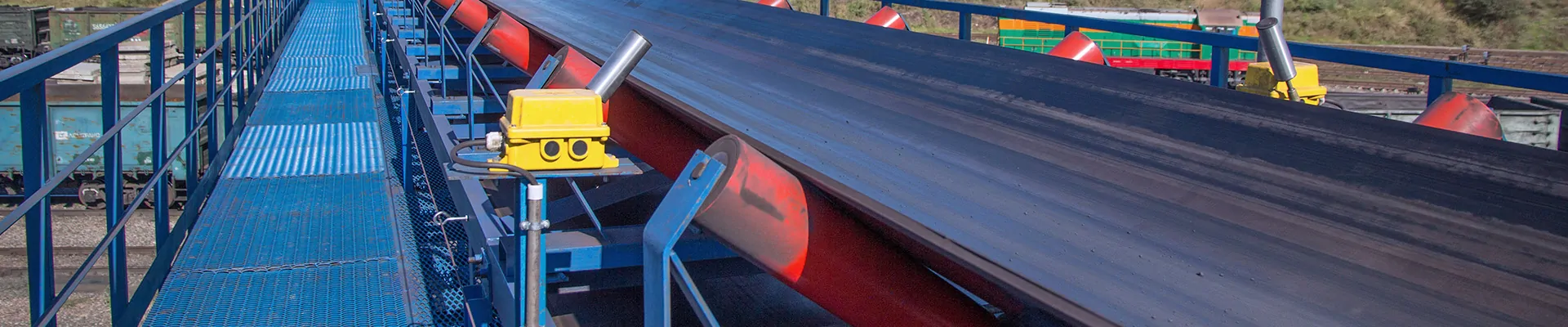
Buffer Beds: Impact Protection & Spillage Control at Conveyor Loading Zones
Buffer Bed is a crucial system installed at conveyor transfer points to cushion the belt against the impact of falling bulk materials. By replacing standard idlers with a solid, impact-absorbing support surface, it prevents belt damage, reduces material spillage, and minimizes wear on conveyor components. Engineered with low-friction slider bars and a robust frame, it ensures smooth belt operation even under the most demanding loading conditions.
Core Advantages:
Belt Protection: Prevents tears, gouges, and premature wear caused by heavy or sharp materials.
Spillage Containment: Seals belt edges with continuous support, keeping material on the belt.
Impact Absorption: Dissipates the force of falling material to protect the belt carcass.
Improved Tracking: Provides full-width support for better belt alignment.
Low Maintenance: Durable design reduces downtime for repairs and component replacement.
Ideal for crusher discharges, screening plants, ship/truck loading stations, and any high-impact transfer point in mining, aggregate, and bulk material handling.
Key Features & Benefits
| Feature |
Benefit |
| Continuous Support Surface |
Eliminates belt sag; prevents "hammocking" and material-induced belt damage |
| Three-Layer Buffer Bar Design |
UHMW-PE top (wear-resistant) + rubber middle (impact-absorbing) + steel base (structural) |
| UHMW-PE Wear Surface |
Ultra-high molecular weight polyethylene provides extremely low friction (μ = 0.1-0.2) and exceptional abrasion resistance |
| High-Elastic Rubber Layer |
Absorbs up to 90% of impact energy; protects belt carcass from shock damage |
| No Rotating Parts |
Eliminates bearing failures, seal failures, and roller jamming common with idlers |
| Self-Cleaning Design |
Continuous surface prevents material build-up between rollers |
| Reduced Belt Stress |
Lowers peak impact pressure; extends belt life by 50% or more |
| Noise Reduction |
Significantly quieter than steel impact rollers |
| Low Maintenance |
No greasing, no bearing replacement; individual buffer bars replaceable |
| Flame Retardant Option |
Special rubber compounds available for underground mining applications |
Product Structure – Component Breakdown
Complete Buffer Bed Assembly
| Component |
Material |
Function |
| Buffer Bar Set |
UHMW-PE + Rubber + Steel |
Absorbs impact; provides low-friction belt surface |
| Main Support Frame |
Q235 Carbon Steel (or Stainless Steel) |
Structural backbone; mounts to conveyor stringers |
| Cross Supports |
Steel Channel |
Provides rigidity across bed width |
| Mounting Legs / Brackets |
Steel Plate with Bolt Holes |
Secures buffer bed to conveyor structure |
| Side Seals / Skirt Clamps (Optional) |
Rubber + Steel |
Prevents material spillage at edges |
| T-Slot / Mounting Hardware |
Aluminum or Steel |
Fastens buffer bars to main frame |
Buffer Bar Detail – Three-Layer Construction
| Layer |
Material |
Thickness |
Function |
| Top Layer (Wear Surface) |
UHMW-PE (Ultra-High Molecular Weight Polyethylene) |
10-15 mm |
Low friction (μ = 0.1-0.2); exceptional wear resistance; smooth belt travel |
| Middle Layer (Cushion) |
High-Elastic Natural Rubber (NR) or SBR |
15-25 mm |
Absorbs impact energy; returns to original shape after compression |
| Bottom Layer (Base) |
Steel (galvanized or painted) |
5-8 mm |
Structural support; attaches to frame via bolts or T-slot |
Manufacturing Note: High-quality buffer bars use hot vulcanization to bond the three layers together, ensuring no separation occurs under repeated heavy impacts .
Technical Specifications
| Parameter |
Standard Range / Value |
| Belt Width Compatibility |
650 mm – 2400 mm (24" – 96") |
| Buffer Bed Length |
1000 mm, 1220 mm, 1500 mm, 1800 mm (customizable) |
| Buffer Bar Width |
100 mm – 150 mm (standard) |
| Number of Buffer Bars |
5 – 18 bars (depending on belt width) |
| UHMW-PE Thickness |
10 mm – 15 mm |
| Rubber Layer Thickness |
15 mm – 25 mm |
| Rubber Hardness |
Shore A 55 – 65 (standard); 45 – 55 (soft for extreme impact) |
| UHMW-PE Hardness |
Shore D 60 – 70 |
| Operating Temperature |
-30°C to +80°C (-22°F to 176°F); special grades available for wider range |
| Maximum Belt Speed |
5.0 m/s (1000 fpm) standard; higher available |
| Maximum Drop Height |
Up to 5 meters (16 ft) standard; heavy-duty designs for higher |
| Maximum Material Lump Size |
Up to 200 mm (8 inches) |
| Maximum Single Lump Weight |
Up to 50 kg (110 lbs) |
| Frame Material |
Q235 Carbon Steel (hot-dip galvanized or painted) |
| Flame Retardant Option |
Yes (for underground mining applications) |
Buffer Bed vs. Impact Idler – Key Differences
| Feature |
Buffer Bed (Impact Bed) |
Impact Idler Set |
| Support Type |
Continuous surface (full-width contact) |
Discrete points (roller contact) |
| Belt Sag Between Supports |
None (0 mm) |
10-30 mm (belt "hammocking") |
| Impact Absorption Mechanism |
Rubber compression + UHMW-PE surface |
Rubber disc compression |
| Risk of Belt Puncture |
Very Low (continuous support prevents "punch-through") |
Moderate (belt sags between rollers) |
| Rotating Parts |
None (no bearings, no seals) |
Yes (bearings, seals can fail) |
| Material Build-Up Risk |
Low (continuous surface self-cleaning) |
High (material collects between rollers) |
| Maintenance Frequency |
Very Low (replace bars every 2-5 years) |
Moderate (replace rollers 1-2 years) |
| Energy Consumption |
Slightly higher (sliding friction vs. rolling friction) |
Lower (rolling friction) |
| Noise Level |
Low (rubber dampens sound) |
Moderate-High (steel roller contact) |
| Best Application |
High drop heights, large lumps, abrasive materials |
Moderate drop heights, uniform materials |
| Relative Cost |
Higher initial investment |
Lower initial investment |
Selection Note: For drop heights under 3 meters (10 feet) and material lump size under 50 mm (2 inches), impact idlers are generally sufficient. For drop heights over 3 meters or lumps over 100 mm (4 inches), a buffer bed is strongly recommended to protect belt life .
Available Configurations
| Type |
Description |
Application |
| Standard Duty Impact Bed |
3-layer buffer bars; standard rubber hardness |
General bulk handling (aggregates, grain, coal) |
| Heavy-Duty Impact Bed |
Thicker buffer bars; reinforced frame; high-elastic rubber |
Mining, quarrying, large lump materials |
| Flame Retardant Impact Bed |
Special rubber compound with flame retardant properties |
Underground mining, coal handling |
| Stainless Steel Impact Bed |
304 or 316 stainless steel frame |
Food processing, chemical plants, corrosive environments |
| Light-Duty Impact Bed |
Fewer buffer bars; lighter frame |
Package handling, light industrial |
| Adaptive Impact Bed |
Spring-loaded buffer blocks that move independently |
Uneven impact zones, variable material flow |
Applications
| Industry |
Typical Use Case |
| Mining (Underground & Surface) |
Crusher discharge, shaft loading points, transfer towers |
| Coal Handling & Power Plants |
Coal crusher house, boiler feed conveyors, transfer points |
| Aggregates & Quarrying |
Primary and secondary crusher discharge, screen feeds |
| Cement Industry |
Limestone crusher discharge, raw mill feed, clinker handling |
| Steel & Smelting |
Ore receival, sinter plant feeds, scrap handling |
| Port & Terminal |
Ship unloader discharge, stacker/reclaimer feed belts |
| Chemical Processing |
Fertilizer handling, corrosive material transfer |
| Recycling & Waste |
Shredder discharge, sorting line feeds |
Recommended Installation Guidelines
| Parameter |
Recommendation |
| Location |
Directly under the chute discharge point, centered on material impact zone |
| Trough Angle |
Must match conveyor belt trough angle (typically 20°, 35°, or 45°) |
| Length |
Extend 300-500 mm beyond material impact zone on each side |
| Side Seals |
Install skirt rubber with clamping system to prevent spillage |
| Transition to Idlers |
Install standard troughing idlers immediately after buffer bed |
| Alignment |
Buffer bed surface must be coplanar with adjacent idler rolls |
| Inspection |
Check UHMW-PE wear every 3-6 months; replace bars when worn to 50% thickness |
Selection Checklist
When ordering a buffer bed, please specify:
Belt width (mm or inches)
Trough angle (20°, 35°, or 45°)
Buffer bed length (standard: 1000, 1220, 1500, or 1800 mm)
Maximum drop height (meters or feet)
Material type, density, and maximum lump size
Expected tonnage (tons per hour)
Belt speed (m/s or fpm)
Frame material (carbon steel painted, hot-dip galvanized, or stainless steel)
Flame retardant required? (Yes/No)
Skirt sealing system required? (Yes/No)
Quantity and spacing requirements
Quality Standards
All buffer beds are manufactured to:
ISO 9001:2015 – Quality management system
DIN standards – Buffer bar performance
CE Marking (available upon request)
GB standards (Chinese national standards)
Each buffer bed undergoes:
UHMW-PE surface hardness test (Shore D)
Rubber layer durometer check (Shore A)
Bond strength test (vulcanization integrity)
Frame dimensional inspection
Weld quality inspection
Buffer bed, impact bed, conveyor impact bed, loading zone support bed, buffer bar, UHMW-PE impact bed, heavy duty impact bed, flame retardant buffer bed, mining impact bed, conveyor loading point protection, impact absorption system, belt protection bed, drop zone support, skirt sealing system, impact bar assembly.