Intelligent Belt Alignment Without External Power
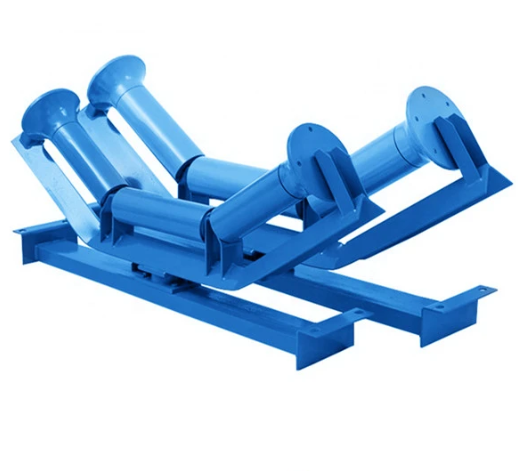
Friction self-aligning idler sets represent an advanced category of conveyor components that automatically correct belt misalignment through purely mechanical, friction-based systems. Unlike conventional fixed idlers or externally-powered alignment solutions, these sophisticated units utilize the belt's own movement and friction forces to detect and instantly correct tracking deviations. This maintenance-free, energy-independent technology provides continuous alignment correction, significantly reducing belt edge wear, spillage, and unscheduled downtime in demanding industrial applications.
Key Features & Benefits
| Feature |
Benefit |
| Friction-Actuated Mechanism |
Instant response to belt drift; no power or pneumatics required |
| Heavy-Duty Pivot Frame |
Robust steel construction withstands continuous pivoting cycles |
| Tapered or Rubber-Faced Friction Rollers |
Creates consistent friction force without damaging belt edges |
| Automatic Self-Centering |
Continuously adjusts to belt position without manual intervention |
| Low Maintenance |
Simple mechanical design with greaseable pivot bearings |
| Sealed Roller Bearings |
Labyrinth seals protect against dust and moisture |
| CEMA / DIN Standard Dimensions |
Interchangeable with standard idler sets |
| Corrosion Protection |
Hot-dip galvanized, painted, or stainless steel options |
Available Configurations
| Type |
Configuration |
Application |
| Carrying Side Self-Aligning Idler |
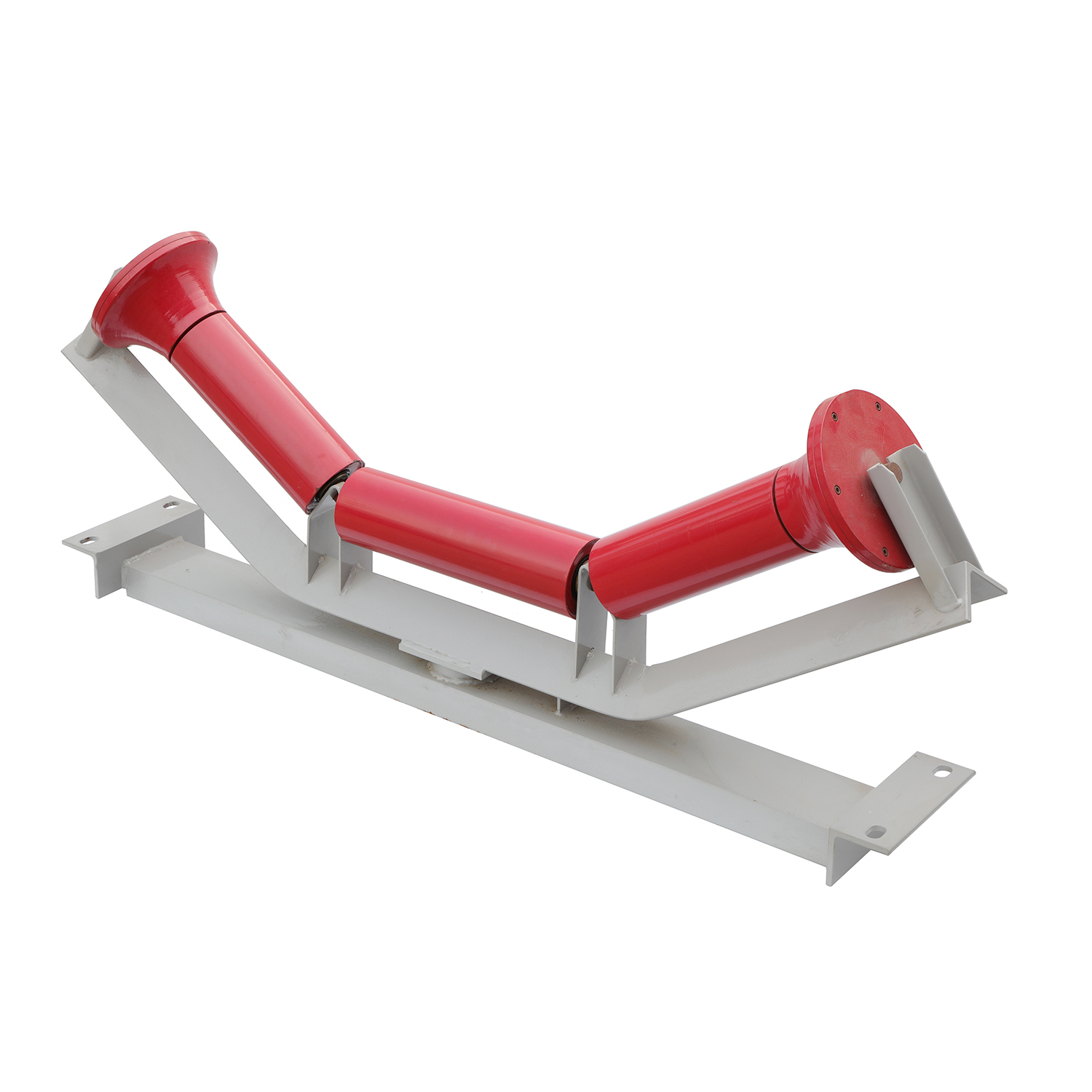
Three-roller troughing set (20°, 35°, or 45°) with friction rollers on both sides |
Main carrying side; corrects belt drift under load |
| Return Side Self-Aligning Idler |
Single V-roller or flat roller with friction discs or tapered ends |
Return side; corrects belt drift on empty belt |
| Heavy-Duty Friction Idler |
Reinforced frame, larger rollers, higher load capacity |
Mining, quarrying, high-tension belts |
| Light-Duty Training Idler |
Smaller frame, lighter construction |
Package handling, light industrial conveyors |
Both left-hand and right-hand pivot directions are available to suit conveyor orientation and belt travel direction.
Technical Specifications
| Parameter |
Carrying Side Model |
Return Side Model |
| Belt Width Range |
400 mm – 2400 mm (16" – 96") |
400 mm – 2400 mm (16" – 96") |
| Trough Angle |
20°, 30°, 35°, 45° |
10° (V-return) or flat |
| Roller Diameter |
89 mm – 159 mm |
89 mm – 133 mm |
| Friction Roller Material |
Rubber lagging or polyurethane coating |
Rubber discs or tapered steel |
| Frame Material |
Heavy-duty steel channel or angle |
Steel channel |
| Pivot Bearing |
Greaseable spherical bearing or bronze bushing |
Same as carrying side |
| Mounting |
Base plate or channel mounting |
Base plate or hanging brackets |
| Pivot Angle |
±15° to ±25° (depending on model) |
±15° to ±25° |
| Operating Temperature |
-30°C to +60°C (-22°F to 140°F) |
Same |
Component Breakdown
| Component |
Material / Specification |
| Carrying Rollers (3 pcs) |
Steel tube, sealed bearings, optional rubber lagging |
| Friction Rollers (2 pcs) |
Rubber-coated or tapered steel, mounted on side frames |
| Side Frames |
Fabricated steel plate with integral friction roller mounts |
| Pivot Frame (Center Frame) |
Heavy steel channel or box section |
| Pivot Shaft / Kingpin |
Hardened steel with grease fitting |
| Base Frame |
Steel plate with mounting holes (bolted or welded to conveyor structure) |
| Limiting Stops |
Adjustable or fixed stops to limit pivot angle |
| Return Roller (return model only) |
Single V-roller or flat roller with friction discs |
Friction Roller Surface Options
| Surface Type |
Friction Level |
Best For |
| Smooth Rubber Lagging |
Medium |
Standard belt drift correction |
| Diamond Pattern Rubber |
High |
Wet or slippery conditions |
| Polyurethane Coating |
Medium-High |
Non-marking, chemical resistance |
| Tapered Steel (no lagging) |
Low-Medium |
Dry, clean environments |
| Rubber Discs (spaced) |
Medium |
Self-cleaning, sticky materials |
Applications
| Industry |
Typical Use |
| Mining |
Long overland conveyors, inclined belts, curved sections |
| Aggregates & Quarrying |
Crushing/screening plants where belt drift is common |
| Cement |
Raw material feed, clinker conveyors |
| Power Generation |
Coal handling systems |
| Port & Terminal |
Ship loading/unloading, stockyard conveyors |
| Bulk Material Handling |
Grain, fertilizer, salt, wood chips, ores |
| Steel & Smelting |
High-temperature applications with expansion-related drift |
Selection Considerations
When selecting a friction self-aligning idler set, specify:
Belt width (mm or inches)
Trough angle (20°, 35°, or 45° for carrying side)
Roller diameter (based on belt speed and load)
Friction roller surface (rubber, polyurethane, or tapered steel)
Mounting type (base plate, channel, or hanging)
Pivot angle range (standard ±15° or custom)
Environmental conditions (wet, dusty, corrosive, high-temp)
Return side requirement (yes/no – if needed for both sides)
Installation Locations
| Position |
Recommendation |
| Feed / Tail End |
One set immediately after the tail pulley |
| Along Conveyor |
Every 30–50 meters (100–165 ft) in long conveyors |
| Before Drive Pulley |
One set at the approach to drive pulley |
| Before Curves |
One set before horizontal or vertical curves |
| At Belt Splicing Points |
Additional sets where belt may have alignment issues |
Typical Spacing: For most conveyors, 3–5 self-aligning idler sets are sufficient per 100 meters. Over-spacing reduces effectiveness; under-spacing increases belt wear.
Self-Aligning Idler vs. Standard Idler
| Feature |
Friction Self-Aligning Idler |
Standard Troughing Idler |
| Belt Tracking |
Automatic correction of drift |
Passive; no correction |
| Pivoting Capability |
Yes (±15° to ±25°) |
No (fixed) |
| Friction Rollers |
Yes (both sides) |
No |
| Frame Complexity |
Higher (pivot mechanism) |
Low (fixed frame) |
| Cost |
Higher than standard idler |
Lower |
| Maintenance |
Moderate (grease pivot bearings) |
Low |
| Application |
Where belt drift is expected or problematic |
General conveying |
Quality Standards
All friction self-aligning idler sets are manufactured to:
ISO 9001:2015 – Quality management system
CEMA B105.1 / B105.2 – Idler dimensional standards
DIN 15207 / ISO 15360 – Roller specifications
JIS B 8803 (upon request)
Each set undergoes:
Frame alignment inspection
Pivot rotation smoothness test
Roller radial runout check (≤0.5 mm)
Friction roller surface integrity check
Friction self-aligning idler, automatic belt tracking idler, self-centering idler set, training idler for conveyor belt, friction-type training idler, belt drift correction idler, pivoting troughing idler, conveyor belt aligner, automatic self-alignment idler, rubber friction roller idler, return side self-aligning idler, heavy duty training idler, CEMA self-aligning idler.