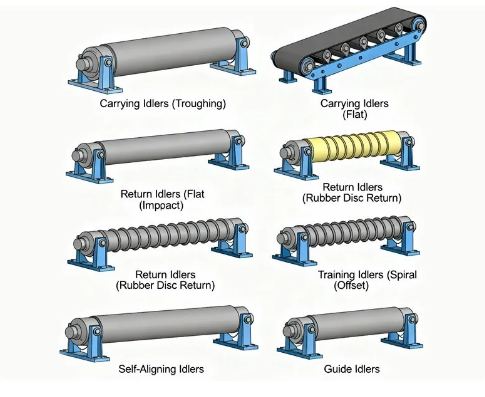
Analysis of how a belt conveyor idler maintains belt tension and prevents material spillage through structural integrity.
Impact of Alignment
Evaluation of how conveyor idlers influence belt tracking and prevent premature edge fraying or structural damage.
Energy Consumption
Discussion on the relationship between idler rolling resistance and the electrical demand required to move the conveyor belt.
Impact Zone Protection
Examination of specialized impact conveyor idlers and their role in absorbing kinetic energy during material loading.
Maintenance and Belt Life
Correlation between idler seizing, shell wear, and the subsequent abrasive damage caused to the conveyor belt surface.
Selection Criteria
Guidelines for choosing the correct belt conveyor idler specifications to match specific belt widths, speeds, and loads.
How Belt Conveyor Idler Components Provide Structural Support
The primary function of a belt conveyor idler is to support the weight of the conveyor belt and the material load, ensuring the belt maintains its intended shape and tension. Without a robust belt conveyor idler framework, the belt would succumb to gravity, leading to excessive sagging that increases friction and material loss.
A well-engineered belt conveyor idler provides a stable cradle for the belt. In the carrying run, the troughing idler sets define the belt's profile, usually at angles of 20, 35, or 45 degrees. This shaping is vital because it increases the cross-sectional area available for material, allowing for higher throughput. If the belt conveyor idler is not spaced correctly, the belt will sag between the rollers. This "catenary" effect causes the material to shift and rub against the belt surface, leading to internal heat buildup and premature aging of the rubber compounds.
Furthermore, the structural support provided by the conveyor idlers ensures that the tension remains uniform across the width of the belt. Uneven support from a damaged belt conveyor idler can cause localized stretching. Over time, this results in a permanent deformation of the belt carcass, making it nearly impossible to track the belt correctly. High-quality rollers from reputable manufacturers ensure that the belt remains flat on the return side and properly troughed on the carrying side, which is the baseline requirement for any high-performance conveyor system.
The interaction between the belt conveyor idler and the belt also dictates the vibration levels within the system. Precision-machined conveyor idlers with low Total Indicated Runout (TIR) minimize the "beating" action against the belt. When a belt conveyor idler is out of round, it creates a rhythmic pounding that can delaminate the belt layers and loosen mechanical fasteners. Therefore, the structural role of the belt conveyor idler extends beyond mere weight-bearing; it is the primary stabilizer of the entire moving mass.
The Influence of Conveyor Idlers on Belt Tracking and Alignment
Properly installed conveyor idlers are the most effective tool for controlling belt tracking, as they apply the necessary steering forces to keep the belt centered on the structure. A belt conveyor idler that is perfectly perpendicular to the belt's path will allow the belt to run true, whereas misaligned idlers will force the belt toward one side, leading to edge damage.
Tracking issues are often the result of a belt conveyor idler set that has shifted due to vibration or poor installation. When the belt moves off-center, it begins to rub against the conveyor frame or the idler brackets. This friction generates intense heat, which can melt the belt edges or cause the fabric reinforcement to unravel. By utilizing training conveyor idlers or self-aligning belt conveyor idler sets, operators can automatically correct these deviations. These specialized idlers pivot in response to belt movement, guiding the belt back to the center without manual intervention.
The relationship between the conveyor idlers and tracking is also affected by the cleanliness of the rollers. If material builds up on a belt conveyor idler, it effectively increases the diameter of the roller in a localized area. This creates a "crown" effect that pulls the belt toward the side with the buildup. Regular maintenance of the belt conveyor idler components is necessary to prevent this "false tracking." Clean, free-rotating conveyor idlers ensure that the steering forces remain balanced across the entire system.
In long-distance conveyor systems, the cumulative effect of belt conveyor idler alignment is massive. Even a one-degree deviation in several conveyor idlers can result in a belt that refuses to stay on the pulleys. Advanced belt conveyor idler designs incorporate adjustable slots in the mounting frames, allowing for fine-tuning of the belt path. This precision is what separates a reliable industrial operation from one plagued by constant downtime and belt replacement costs.
Key Tracking Benefits of Quality Idlers:
Reduction in edge wear and belt fraying
Prevention of material spillage due to off-center loading
Decrease in labor costs associated with manual belt alignment
Extension of the lifespan of both the belt and the conveyor structure
Reducing Energy Costs through Efficient Belt Conveyor Idler Design
The rolling resistance of a belt conveyor idler is a major contributor to the overall energy consumption of a conveyor system, directly impacting the power required from the motor. By selecting a belt conveyor idler with low-friction bearings and high-quality seals, companies can significantly reduce the "drag" on the belt, leading to lower utility bills and reduced strain on the drive system.
The energy efficiency of a belt conveyor idler is measured by its rotating resistance. When a conveyor belt moves over thousands of conveyor idlers, even a small amount of resistance in each roller adds up to a massive load. A high-quality belt conveyor idler utilizes precision ball bearings and specialized lubrication that remains fluid across a wide temperature range. This ensures that the belt conveyor idler starts easily and continues to rotate with minimal effort, allowing the belt to glide over the surface rather than being dragged across stagnant rollers.
Furthermore, the design of the belt conveyor idler seal plays a dual role in energy efficiency. While the seal must protect the bearing from dust and moisture, it should not exert excessive "drag" on the shaft. Modern belt conveyor idler designs use non-contact labyrinth seals that provide excellent protection without the friction associated with traditional felt or rubber contact seals. This reduction in internal friction within the conveyor idlers translates directly into a reduction in the kilowatt-hours consumed by the conveyor drive motor.
In addition to the internal mechanics of the belt conveyor idler, the weight of the idler shell itself matters. Lighter, well-balanced conveyor idlers require less torque to initiate rotation. When a system utilizes optimized belt conveyor idler sets, the tension required to move the belt is lower. Lower belt tension means the belt itself can be lighter and more flexible, which further reduces the energy lost to "indentation rolling resistance"—the energy consumed when the belt deforms over each belt conveyor idler.
Comparison of Idler Features and Energy Impact:
Idler Feature
Impact on Belt Conveyor
Energy Result
Precision Bearings
Smoother belt conveyor idler rotation
Lower motor torque required
Labyrinth Seals
Reduced internal friction
Decreased power consumption
Low TIR Shells
Minimal belt vibration
Reduced energy dissipation
Optimized Spacing
Less belt sag between idlers
Lower movement resistance
Protecting the Belt Carcass with Specialized Impact Conveyor Idlers
Impact conveyor idlers are specifically designed to absorb the shock of falling material at loading points, preventing the belt conveyor idler from acting as an anvil that crushes the belt carcass. These specialized conveyor idlers feature rubber rings or cushions that compress under load, dissipating the kinetic energy that would otherwise cause punctures or tears in the belt.
The loading zone is the most dangerous area for a conveyor belt. When heavy or sharp materials are dropped from a height, they hit the belt with immense force. If a standard steel belt conveyor idler is located directly under the impact point, the belt is trapped between the falling rock and the rigid steel roller. This often results in "crushing" damage, where the internal fabric or steel cords of the belt are snapped. By replacing standard sets with an impact-style belt conveyor idler, the system gains a "buffer" that protects the belt's structural integrity.
A high-performance impact belt conveyor idler consists of a heavy-duty steel shaft covered with high-elasticity rubber discs. As the material hits the belt, these discs deform, increasing the contact time and reducing the peak force exerted on the belt rubber. This protection is vital for maintaining the "cover" of the belt. Once the cover is breached, moisture can enter the carcass of the belt, leading to rot in fabric belts or corrosion in steel-cord belts. Using the correct impact belt conveyor idler is an insurance policy against the most common cause of premature belt replacement.
Moreover, the configuration of the impact belt conveyor idler set is usually reinforced to handle higher dynamic loads. The frames are often made of heavier gauge steel to prevent bending under the constant hammering of the loading process. When integrated correctly, these conveyor idlers ensure that the transition from a stationary state to a moving state is as gentle as possible for the belt. This synergy between the impact belt conveyor idler and the belt surface is what allows systems to handle aggressive materials like ore, coal, and crushed stone for years without failure.
Managing Belt Wear and Tear Caused by Conveyor Idler Failure
A seized or damaged belt conveyor idler acts as a stationary abrasive surface that rapidly grinds away the bottom cover of the conveyor belt. When a conveyor idler stops rotating due to bearing failure or material jamming, it becomes a "slider bar" that creates intense friction, leading to localized thinning and eventual failure of the belt.
The most common sign of a failing belt conveyor idler is the presence of "flat spots" on the roller shell. Once a belt conveyor idler stops turning, the moving belt begins to wear away one side of the roller. Eventually, the roller shell can be worn through completely, leaving sharp, jagged edges of steel. These edges act like knives, capable of slicing through a multi-ply conveyor belt in a matter of minutes. Regular inspection of every belt conveyor idler is required to catch these "frozen" rollers before they cause irreparable damage to the belt.
Beyond physical slicing, a failed belt conveyor idler increases the heat at the interface. This heat can "vulcanize" or harden the belt's bottom cover, making it brittle and prone to cracking. As the belt loses its flexibility, it can no longer wrap around pulleys efficiently, leading to slippage and further heat generation. The belt conveyor idler is the primary contact point for the belt; if that contact point is not rotating, the entire system is effectively "braking" against the motor, which stresses the belt's tensile members.
Maintenance teams must also be aware of "shell carry-over" on the conveyor idlers. If a belt conveyor idler is corroded or pitted, it acts like sandpaper on the belt. In B2B environments like chemical plants or salt mines, the corrosion of the belt conveyor idler is a major concern. Utilizing specialized coatings or composite conveyor idlers can prevent this abrasive wear. Protecting the belt starts with ensuring that every single belt conveyor idler in the line is in peak mechanical condition, as one single failed roller can destroy thousands of dollars worth of belting.
Signs of Idler-Induced Belt Damage:
Grooves or longitudinal lines on the bottom of the belt
Hardened or "shiny" spots on the rubber cover
Frayed edges coinciding with misaligned idler frames
Excessive rubber dust accumulating under the idler sets
Optimization Strategies for Matching Belt Conveyor Idler to Belt Specifications
Optimizing the interaction between the belt conveyor idler and the conveyor belt requires a precise match of idler diameter, spacing, and troughing angle to the specific mechanical properties of the belt. Selecting a belt conveyor idler based solely on price often leads to a mismatch that causes belt stress, high energy use, and frequent maintenance intervals.
The diameter of the belt conveyor idler is one of the most important factors. Larger diameter conveyor idlers rotate at a lower RPM for the same belt speed, which extends the life of the idler bearings and reduces the frequency of the "flexing" cycle for the belt. For heavy-duty belts, a larger belt conveyor idler provides a wider support base, reducing the pressure on the belt carcass. Engineering standards provide specific formulas to determine if a 127mm, 152mm, or 178mm belt conveyor idler is appropriate for the given load and belt thickness.
Idler spacing is another critical optimization variable. If the belt conveyor idler sets are too far apart, the belt sag will exceed the recommended 2% limit, causing material to "bounce" as it passes over each idler. This bouncing action increases the wear on the belt conveyor idler and creates dust. Conversely, spacing the conveyor idlers too closely increases the initial capital cost and the total rolling resistance of the system. Finding the "Goldilocks" zone for belt conveyor idler placement is a hallmark of a well-designed system.
Finally, the troughing angle of the belt conveyor idler must match the belt's flexibility. If a rigid belt is forced into a 45-degree belt conveyor idler set, the belt may "bridge," where the center of the belt does not touch the center roller. This causes the belt to wander and places all the material weight on the edges of the belt, leading to structural failure. Proper selection involves analyzing the belt's transverse stiffness and ensuring it can transition smoothly into the trough provided by the belt conveyor idler.
Technical Selection Checklist:
Belt Width: Ensures the belt conveyor idler frame is wide enough to prevent edge rubbing.
Material Density: Dictates the load capacity required for the belt conveyor idler bearings.
Belt Speed: Determines the required balance and RPM rating of the conveyor idler.
Environmental Conditions: Influences the choice of belt conveyor idler seal and shell material (e.g., galvanized, stainless, or polymer).