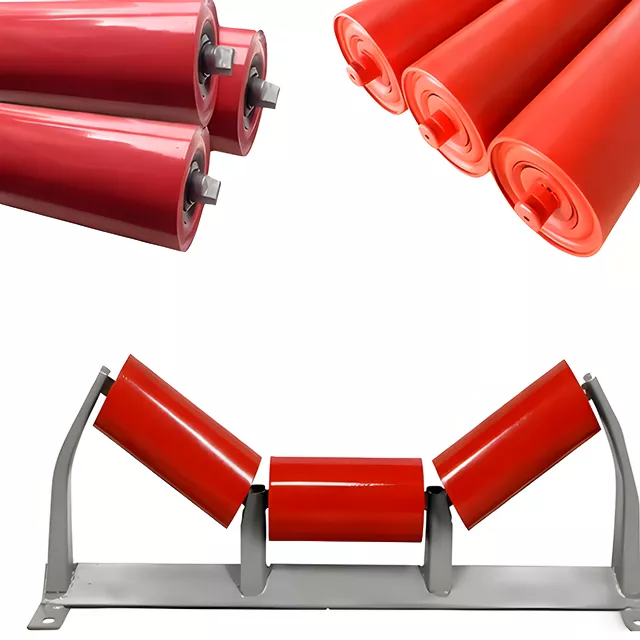
An overview of the fundamental roles of the belt conveyor idler in supporting the belt and managing material load.
Conveyor Idler Alignment
A technical explanation of the geometric requirements for proper conveyor idler placement relative to the frame.
Impacts Of Conveyor Idler Misalignment
A detailed analysis of the negative consequences of skewed idlers, including belt damage and energy loss.
Causes Of Idler Misalignment
An investigation into why idlers become misaligned, ranging from installation errors to structural shifts.
Measuring And Correcting Idler Misalignment
Practical methods and tools for detecting and fixing alignment issues to restore system efficiency.
Conveyor Idler Basics
A belt conveyor idler is a cylindrical component that supports the conveyor belt and the conveyed material, ensuring the belt maintains its shape and path while reducing friction during movement.
The belt conveyor idler is more than just a simple roller; it is a precision engineered assembly consisting of a shell, bearings, seals, and an internal shaft. These units are strategically spaced along the length of the conveyor frame to provide a continuous support surface. In a typical industrial setup, you will find carrying idlers on the top side to support the loaded belt and return idlers on the bottom to support the empty belt as it travels back to the loading point. The design of the conveyor idler must account for the weight of the material, the speed of the belt, and the environmental conditions of the facility.
Properly functioning idlers ensure that the belt forms a consistent trough, which is vital for containing bulk materials and preventing spillage. High quality conveyor idler sets are manufactured to minimize rotational resistance, which directly correlates to the energy efficiency of the motor driving the system. When the belt conveyor idler rotates freely and is positioned correctly, it provides a stable platform that allows the belt to glide with minimal resistance.
Furthermore, the materials used in the construction of a conveyor idler are selected based on the specific application. For instance, in mining or heavy industrial environments, idlers may feature reinforced steel shells and advanced sealing systems to protect the bearings from dust and moisture. The synergy between the belt conveyor idler and the belt is what determines the reliability of the material handling process. Without these essential components, the belt would sag, material would spill, and the mechanical load on the drive system would become unsustainable.
Conveyor Idler Alignment
Conveyor idler alignment refers to the precise positioning of the idler sets so that their rotational axes are perfectly perpendicular to the direction of the belt travel and parallel to the horizontal plane of the conveyor frame.
Achieving perfect alignment for a belt conveyor idler requires meticulous attention to the geometry of the conveyor structure. Each idler frame must be squared with the stringers, ensuring that the center point of the conveyor idler set aligns with the longitudinal centerline of the conveyor. If an idler is "knocked" or skewed even by a few degrees, it acts like the steered wheels of a vehicle, forcing the belt to move toward one side. This directional force is a primary driver of belt tracking issues.
In addition to horizontal squaring, vertical alignment is equally crucial. A belt conveyor idler that is tilted too far forward or backward can create uneven pressure points on the belt. This is often seen in "training" idlers which are intentionally skewed to correct a mistracking belt, but when standard idlers are unintentionally misaligned, they create conflicting forces that stress the belt carcass. Proper alignment ensures that the force exerted by the conveyor idler is strictly upward and supporting, rather than lateral.
The process of aligning a belt conveyor idler involves using the conveyor frame as a reference point. Professionals often use string lines, laser levels, or transit levels to ensure that every conveyor idler in a long run is on the same plane. Because industrial floors can settle and steel structures can flex under load, alignment is not a one time task but a continuous requirement of a healthy maintenance schedule. A well aligned conveyor idler system results in a belt that "runs true," centered on the rollers without constant manual intervention.
Impacts Of Conveyor Idler Misalignment
The primary impacts of conveyor idler misalignment include severe belt edge damage, accelerated wear on the idler shell, increased energy consumption, and high risks of material spillage and structural interference.
Belt Tracking and Edge Damage
When a belt conveyor idler is misaligned, it exerts a side thrust on the belt. This force pushes the belt toward the side of the conveyor, causing it to rub against the frame or nearby structures. This constant friction quickly shreds the edges of the belt, exposing the internal fabric or steel cords. Once the edge is compromised, moisture can penetrate the belt carcass, leading to rot or corrosion and ultimately requiring a full belt replacement.
Increased Power Consumption and Friction
A misaligned conveyor idler does not roll in harmony with the belt; instead, it creates a "skidding" effect. This sliding friction requires significantly more torque from the drive motor to overcome. Over a long conveyor system with hundreds of idlers, even a small percentage of misaligned belt conveyor idler units can lead to a measurable increase in electricity costs. The motor must work harder to pull the belt through the resistance created by the skewed rollers.
Component and Structural Wear
The stresses of misalignment are not limited to the belt. A belt conveyor idler that is forced to deal with lateral loads will experience uneven bearing wear. Bearings are typically designed for radial loads, but misalignment introduces axial forces that can lead to premature bearing failure and seized rollers. Furthermore, the vibration and heat generated by a mistracking belt can cause fatigue in the conveyor stringers and mounting brackets, leading to long term structural instability.
Impact Category
Specific Consequence
Long Term Result
Belt Health
Edge fraying and carcass exposure
Total belt failure and replacement
Energy Efficiency
Higher motor amperage draw
Increased operational utility costs
Hardware Life
Bearing seizing and shell flat spots
High frequency of conveyor idler replacement
Safety/Environment
Material spillage and dust generation
Increased cleaning labor and safety hazards
Causes Of Idler Misalignment
Idler misalignment is commonly caused by improper initial installation, structural shifts in the conveyor frame, accumulation of material buildup on the rollers, and the physical impact of heavy loads during operation.
One of the most frequent causes of a misaligned belt conveyor idler is poor installation practices. If the mounting holes in the conveyor stringers are not perfectly aligned or if the idler frames are forced into position during assembly, the conveyor idler starts its life in a skewed state. Over time, the vibration of the system can loosen the mounting bolts, allowing the belt conveyor idler to shift further out of its original position. This is especially common in systems that do not use locking washers or high torque fastening methods.
Environmental factors and material handling habits also play a major role. For instance, if the material being moved is sticky or abrasive, it can build up on the surface of the conveyor idler. This "carryback" changes the effective diameter of the roller. If the buildup is uneven, it creates a tapered effect on the belt conveyor idler, which mimics the effect of a misaligned frame and steers the belt to one side. Similarly, the impact of large, heavy rocks or ores at the loading zone can physically bend the conveyor idler brackets, knocking them out of alignment.
Finally, the integrity of the conveyor structure itself must be considered. In outdoor environments, the ground beneath the conveyor supports may settle unevenly due to rain or soil erosion. As the frame twists or bows, the conveyor idler sets mounted to it are pulled out of their perpendicular orientation. Regular inspections are necessary to ensure that the "backbone" of the system remains straight and level, as even the highest quality belt conveyor idler cannot function correctly on a warped frame.
Measuring And Correcting Idler Misalignment
Measuring and correcting idler misalignment involves using precision tools like laser trackers or string lines to identify skewed sets and then physically adjusting the idler frames to be perpendicular to the belt path.
The first step in addressing a problematic belt conveyor idler is a thorough inspection while the system is running (if safe) and while it is locked out. Maintenance teams look for "tracking" indicators, such as the belt consistently riding to one side at a specific point in the conveyor. By tracing the mistracking back to the point where it begins, technicians can pinpoint the specific conveyor idler or group of idlers that are causing the steering effect. Using a square and a reference line, the angle of the belt conveyor idler relative to the frame can be measured.
Correction involves a process often called "knocking the idlers." By loosening the mounting bolts on one side of the belt conveyor idler frame, the technician can slightly shift the position of the roller. A common rule of thumb in the industry is that the belt moves toward the side of the conveyor idler it contacts first. Therefore, to move the belt to the left, the right side of the belt conveyor idler should be moved forward in the direction of belt travel. This adjustment must be done in small increments, as overcorrecting can lead to a "hunting" belt that zig zags down the line.
For long term reliability, modern facilities are increasingly turning to self aligning or "training" conveyor idler sets. these specialized units feature a pivoting mechanism that automatically reacts to a mistracking belt, shifting the belt conveyor idler position to guide the belt back to the center. However, these should be seen as a secondary defense; the primary goal should always be to ensure the standard belt conveyor idler units are manually aligned to the highest possible standard during routine maintenance.
Establish a centerline using a transit or laser tool.
Check the squareness of every tenth belt conveyor idler set.
Inspect for material buildup and clean all rollers.
Adjust the skewed idlers by shifting the mounting brackets.
Secure all bolts and verify the belt tracking under full load.