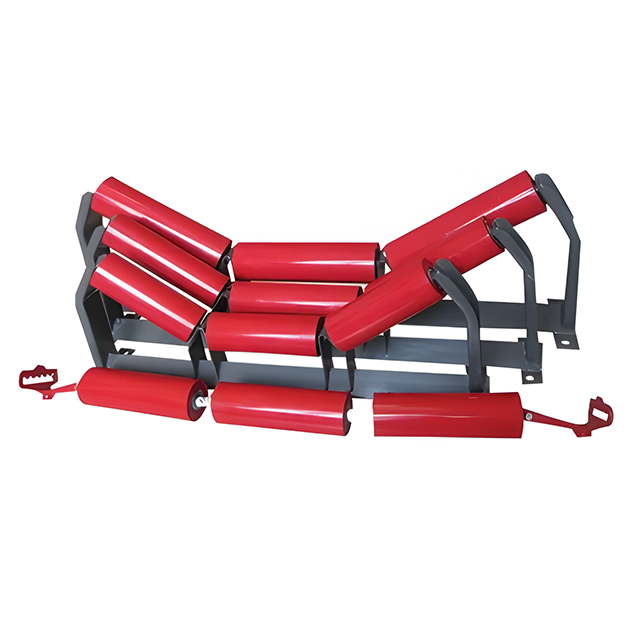
The fundamental choice between rubber conveyor belts and PVC conveyor belts centers on mechanical toughness, thermal endurance, and operational environment: heavy-duty rubber conveyor belts excel in high-impact, abrasive, heavy-tonnage bulk handling (such as mining, aggregate, and steel processing) due to superior elasticity, tensile strength, and high-temperature tolerance, whereas PVC conveyor belts are ideal for light-to-medium handling, indoor logistics, parcel sorting, and food-grade operations due to their lightweight flame-retardant structure, chemical resistance, and cost efficiency. Optimal belt performance in both systems requires matching rubber conveyor rollers and idlers to absorb impact kinetic energy and protect belt carcass integrity.
At a Glance
Section
Summary
What is a Rubber Conveyor Belt?
Detailed analysis of rubber belt construction, elastomeric vulcanization, high-tensile fabric/steel carcass layers, and heavy-duty bulk handling performance supported by specialized rubber conveyor rollers.
What is A PVC Conveyor Belt?
Examines thermoplastic polyvinyl chloride belt design, monofilament carcass construction, flame retardation, moisture resistance, and precision light-to-medium material conveyance.
Key Differences Between PVC and Rubber Conveyor Belts
Comparative engineering review covering tensile modulus, durometer hardness, impact attenuation, coefficient of friction, and maintenance profiles with rubber conveyor rollers.
What is a Rubber Conveyor Belt?
A rubber conveyor belt is a high-strength, flexible material handling belt constructed from vulcanized natural or synthetic rubber compound covers reinforced with internal textile or steel cord carcasses, engineered specifically for high-tonnage, severe-impact, and highly abrasive bulk material transport across demanding industrial operations.
In heavy industrial material transport, rubber conveyor belts represent the foundational backbone of high-capacity bulk logistics. The structural engineering of a rubber belt relies on cross-linked polymer chemistry, wherein raw elastomers undergo thermal vulcanization with sulfur or peroxide curing agents. This chemical reaction creates a three-dimensional molecular network that yields extraordinary elasticity, tensile memory, and energy absorption capability. The top and bottom rubber covers are formulated with targeted additives—such as carbon black fillers, anti-ozonants, and plasticizers—to withstand severe environmental degradation, cutting, gouging, and continuous abrasion from sharp ore fragments, coal, or granite aggregates.
Beneath the heavy elastomer covers lies the structural carcass, which carries the longitudinal operating tension. Rubber belts utilize multi-ply woven synthetic fabrics—typically nylon (NN) or polyester-polyamide (EP)—or high-tensile steel cords embedded in specialized rubber tie-gum layers. To maintain structural integrity and prevent premature carcass delamination under severe impact zones, system integration demands proper support components. Utilizing high-performance rubber conveyor rollers and idlers at transfer loading points cushions the heavy drop of lump materials, distributing shock loads and preserving both the belt cover elastomer and internal carcass plies from puncture failures.
From an engineering design perspective, European and global industrial operators increasingly prioritize conveyor efficiency, belt tracking stability, and noise mitigation. Heavy rubber belts exhibit high mass per meter, requiring precise dynamic balancing across return and carrying idlers. Standard steel rollers can suffer from severe material build-up when handling moist or sticky bulk commodities, leading to severe belt misalignment and edge wear. Installing specialized rubber conveyor rollers with rubber rings or rubber discs provides self-cleaning properties that shed sticky carryback, ensuring consistent belt tracking and preventing catastrophic cover gouging.
Benefits of Rubber Conveyor Belts
The operational advantages of rubber conveyor belts stem directly from the superior elastomeric properties of vulcanized rubber compounds. When properly supported by precision-engineered rubber conveyor rollers, these belts deliver unmatched reliability in severe duty cycles:
Exceptional Impact and Puncture Absorption: Vulcanized rubber possesses a high damping capacity, allowing it to deform elastically under heavy kinetic impact and rebound without permanent structural deformation. When drop heights exceed two meters, combining rubber belts with impact rubber conveyor rollers cushions the collision zone, absorbing thousands of Joules of kinetic energy.
Superior Abrasion and Tear Resistance: Formulated with high DIN-abrasion grade compounds (such as DIN X, Y, or W standards), rubber covers resist continuous scrubbing from micro-abrasive fines, sharp aggregates, and crushed quartz, resulting in extended service life under heavy abrasive loading.
Wide Thermal Operating Envelope: High-grade synthetic rubber formulations (such as EPDM or Chloroprene) operate continuously in extreme thermal environments ranging from arctic temperatures as low as -40°C up to elevated thermal bulk conditions exceeding +200°C.
High Troughability and Dynamic Flexibility: Rubber belts naturally form steep trough angles (up to 45 degrees) without stress cracking along the belt center line, allowing maximum volumetric material carrying capacity while maintaining intimate contact with troughing rubber conveyor rollers.
Excellent Friction Coefficient for Drive Traction: Rubber covers feature a naturally high coefficient of friction against drive pulleys and return idlers, preventing belt slip during high-torque startup conditions under full load capacity.
Limitations of Rubber Conveyor Belts
Despite their dominance in heavy bulk transport, rubber conveyor belts exhibit technical limitations that must be addressed during system specification and mechanical sizing:
Higher Volumetric Mass and Power Consumption: Rubber belts carry a substantially higher dead weight per square meter compared to synthetic thermoplastic belts. This higher mass increases drive motor torque requirements, requiring larger gearboxes, heavier structural framing, and robust rubber conveyor rollers to manage rotational inertia.
Elevated Initial Capital Investment: The complex multi-stage vulcanization process, heavy fabric or steel reinforcement layers, and specialized rubber compounds result in significantly higher initial procurement costs per meter relative to light-duty PVC alternatives.
Susceptibility to Hydrocarbon Swelling: Standard natural and styrene-butadiene rubber (SBR) compounds absorb petroleum-based oils, fats, and organic solvents. Exposure causes chemical swelling, cover softening, loss of tensile strength, and ply separation unless specialized Nitrile (NBR) rubber compounds are specified.
Vulcanized Splicing Complexity: Joining rubber conveyor belts requires labor-intensive hot vulcanization equipment, specialized rubber cement, precise temperature control, and extended downtime during field installation.
Technical Parameter
Standard Fabric Rubber Belt
Steel Cord Rubber Belt
Top Cover Elastomer Options
SBR, Natural Rubber, EPDM, NBR
Heavy-Duty SBR, High-Abrasion Natural Rubber
Tensile Rating Range
200 N/mm to 3,150 N/mm
1,000 N/mm to 7,500 N/mm
Maximum Trough Angle
45 Degrees
45 to 60 Degrees
Elongation at Break
10% to 15% (Fabric Ply)
Less than 0.25% (Steel Cord)
Recommended Support Component
Impact & Return Rubber Conveyor Rollers
Heavy-Duty Disc-Type Rubber Conveyor Rollers
What is A PVC Conveyor Belt?
A PVC conveyor belt is a lightweight to medium-duty conveyor belt composed of polyvinyl chloride thermoplastic coatings fused over monofilament or multifilament polyester fabric carcasses, offering excellent chemical resistance, flame retardation, and smooth surface hygienic operation.
Polyvinyl chloride (PVC) conveyor belts represent a modern thermoplastic solution engineered primarily for indoor industrial processing, logistics, parcel distribution, and light bulk handling. Unlike thermoset vulcanized rubber, PVC is a synthetic thermoplastic polymer modified with plasticizers to achieve flex fatigue endurance. The manufacturing process involves coating woven synthetic fabrics—most commonly rigid polyester monofilament warp and weft fibers—with liquid PVC plastisol layers, followed by thermal gelation. This monolithic construction yields a lightweight, dimensional stable structure with high transverse rigidity.
The structural rigidity provided by polyester monofilament fabric prevents belt cupping, curling, and edge wear under mechanical tracking forces. This makes PVC belts highly suitable for slider bed conveyors, automated sorting systems, and small-pulley transfers where precise flat belt positioning is required. However, because PVC thermoplastics have lower kinetic shock absorption compared to thick elastomeric rubber, high impact drops can cause micro-fracturing of the PVC top layer. In transition zones where PVC belts interface with heavier material flows, integrating smooth-running heavy-duty rubber conveyor rollers reduces mechanical vibrations, cushions structural impacts, and prevents premature frame fatigue.
European client feedback and international engineering preferences heavily emphasize energy efficiency, low operating noise, and strict compliance with indoor health and safety standards. PVC belts are inherently flame retardant (satisfying ISO 340 and EN 12882 fire safety regulations for underground parcel facilities) and emit minimal dust compared to degrading rubber. Furthermore, because PVC belts draw less electrical amperage due to reduced belt mass, they offer attractive operational cost savings for large-scale warehouse distribution centers operating thousands of meters of automated roller and belt conveyors.
Benefits of PVC Conveyor Belt
PVC conveyor belts deliver distinct operational advantages in light-to-medium industrial environments, logistics facilities, and chemical processing plants:
Excellent Chemical and Solvent Resistance: Polyvinyl chloride exhibits exceptional inertness when exposed to inorganic acids, alkalis, salts, alcohols, and aliphatic hydrocarbons, preventing material degradation in aggressive chemical washdown zones.
Inherent Flame Retardancy and Safety Compliance: Formulated with chlorine molecules within the polymer chain, PVC possesses self-extinguishing properties that hinder flame propagation, meeting stringent indoor safety standards.
Low Weight and Reduced Energy Requirements: The low density of PVC plastisol combined with thin monofilament fabric layers results in significantly lower belt mass, reducing motor power consumption and mechanical stress on drive components.
Cost-Effective Capital Procurement: Thermoplastic gelation processing is highly efficient, making PVC conveyor belts significantly more economical to purchase and replace than heavy vulcanized rubber belts.
High Hygiene and Easy Cleanability: Non-porous PVC cover surfaces prevent bacterial embedded growth, resist moisture absorption, and tolerate frequent CIP (clean-in-place) chemical washdowns.
Limitations of PVC Conveyor Belt
While PVC belts excel in indoor logistics and chemical processing, key material limitations restrict their performance in harsh bulk environments:
Cold Temperature Embrittlement: PVC thermoplastics experience glass transition changes at sub-zero temperatures. Exposure to temperatures below -10°C causes plasticizers to stiffen, leading to surface cracking, loss of flexibility, and catastrophic belt cracking under bending stresses.
Lower Impact and Cut Resistance: PVC lacks the rebound resilience of vulcanized rubber elastomers. Sharp mineral rocks or heavy impact drops readily puncture, gouge, or tear the thin PVC top layer, exposing the internal fabric carcass.
Thermal Softening under High Temperatures: Continuous exposure to ambient or material temperatures above +80°C causes PVC plastisol to soften, increase tackiness, and lose tensile strength, leading to belt stretching and tracking instability.
Lower Friction Coefficient on Drive Pulleys: Smooth PVC bottom covers exhibit lower dry friction coefficients compared to rubber, requiring higher take-up tension or rubber-lagged drive pulleys to prevent slippage.
Key Differences Between PVC and Rubber Conveyor Belts
The key differences between PVC and Rubber Conveyor Belts lie in polymer structure (thermoplastic vs. vulcanized thermoset), tensile strength capabilities, impact energy absorption, operating thermal limits, and support structure demands.
To fully evaluate the mechanical variance between PVC and rubber conveyor belts, conveyor system designers must analyze material behavior across multiple operating dimensions. Rubber belts utilize thermoset elastomeric polymers that undergo irreversible chemical cross-linking during manufacturing. This gives rubber belts continuous elastic memory, superior tear propagation resistance, and dynamic resilience. Conversely, PVC belts rely on thermoplastic polyvinyl chloride polymers that soften when heated and harden when cooled. This fundamental polymer difference governs how each belt responds to tensile stress, mechanical shock, and environmental exposure.
In high-capacity material handling systems, impact forces at feed hoppers can inflict severe damage on belt structures. Rubber belts, due to their thick elastomeric covers and elastic carcass construction, absorb and dissipate kinetic energy across a wide surface area. However, the belt alone cannot dissipate extreme impact energies without proper support. Integrating impact rubber conveyor rollers directly beneath the loading zone creates an engineered energy-absorption matrix. Rubber impact rollers utilize heavy rubber rings mounted over a steel core to yield mechanically under shock loading, protecting the belt carcass from localized shear stresses and preventing frame cracking.
Another major technical distinction is belt troughability and tracking behavior. Rubber conveyor belts feature high longitudinal and transverse flexibility, enabling them to conform seamlessly to deep 35-degree and 45-degree troughing idler sets. This troughing capability maximizes cross-sectional material load without causing centerline carcass stress. PVC belts, while featuring high transverse rigidity (which prevents belt bowing on flat slider beds), possess limited deep troughing ability. When running PVC belts on troughed idler sets, care must be taken to prevent top cover cracking along the crease line. Utilizing smooth rubber conveyor rollers on return and transition runs provides gentle belt guidance, minimizing mechanical wear on PVC edge profiles.
Conveyor System Maintenance Tip: Always match support idler durometer hardness to the belt cover formulation. In heavy bulk systems using high-tensile rubber belts, deploy impact rubber conveyor rollers with a 60-70 Shore A durometer rubber ring set at loading points. For return runs, use rubber disc return idlers to continuously break up sticky carryback, preventing severe belt tracking offset and premature edge wear.
Neither belt type is universally superior; rubber conveyor belts are better suited for heavy-duty, high-impact, abrasive bulk handling in outdoor mines and steel mills, whereas PVC conveyor belts are superior for indoor logistics, automated packaging, chemical washdowns, and light manufacturing.
Determining which belt material is superior requires a detailed technical evaluation of the operating environment, conveyed material properties, mechanical duty cycles, and lifecycle cost targets. In engineering design, specifying a belt that is over-engineered for an application introduces unnecessary capital costs and higher electrical consumption, while specifying an under-engineered belt leads to frequent belt tearing, high maintenance downtime, and catastrophic failure.
From an operational standpoint, heavy industrial clients handling primary extracted minerals (such as iron ore, copper, limestone, or coal) prioritize extreme mechanical ruggedness, cut resistance, and deep trough carrying capacity. In these severe environments, rubber conveyor belts represent the only technically viable choice. The high tensile strength of steel-cord or multi-ply rubber belts allows continuous operation over transport distances spanning several kilometers. When paired with heavy-duty rubber conveyor rollers, these systems absorb repetitive shock loads at transfer points, maintaining steady material flow without structural degradation.
Conversely, for clients operating indoor parcel logistics centers, automated fulfillment warehouses, or light industrial packaging lines, PVC conveyor belts offer clear technical and financial advantages. The light weight of PVC belts minimizes inertia during rapid start-stop sequences, while their low flame spread index satisfies stringent indoor safety codes. In European logistics facilities, engineers frequently select PVC belts operating over precision slider beds and quiet rubber conveyor rollers to maintain low decibel operating levels (below 65 dBA) and optimize overall facility energy efficiency.
PVC VS Rubber Conveyor Belt: Durability & Strength
Rubber conveyor belts deliver significantly higher durability and ultimate tensile strength compared to PVC belts, offering superior resistance against gouging, tearing, dynamic fatigue, and high-tonnage continuous shock loads.
Structural durability in conveying systems is defined by a belt's ability to withstand tensile stress, mechanical impact, tear propagation, and surface abrasion over millions of flex cycles. Rubber conveyor belts achieve extraordinary durability through high cover-to-carcass adhesion forces and thick elastomeric top and bottom covers. Natural and synthetic rubber compounds deform elastically when struck by heavy sharp lump materials (such as primary crushed stone), dissipating impact kinetic energy without tearing the top cover or fracturing internal fabric plies.
PVC conveyor belts, while possessing high tensile modulus per unit thickness due to monofilament polyester fabric plies, exhibit lower total tensile strength limits and reduced cut resistance. Under high impact loads, thermoplastic PVC can experience plastic deformation or shearing along the impact site. To maximize durability in transition zones where PVC or rubber belts meet heavy support structures, engineers specify rubber conveyor rollers and idlers. Rubber rollers cushion belt flex cycles over support frames, reducing internal shear stress within the carcass plies and significantly extending total fatigue life.
Furthermore, dynamic abrasion durability varies significantly between the two polymer types. In standard DIN abrasion testing (which measures volumetric material loss when rubbed against abrasive paper), high-grade rubber cover compounds lose less than 70 mm³ of material volume under standard load. Standard PVC compounds experience material loss exceeding 150 to 200 mm³ under identical test parameters. Consequently, in handling sharp, abrasive bulk solids, rubber belts yield a significantly longer continuous operating service life.
Durability Metric
Heavy-Duty Rubber Belt
Standard PVC Belt
Max Tensile Rating (ST Grade)
Up to 7,500 N/mm
Up to 1,200 N/mm
Impact Energy Tolerance
Very High (>2,500 Joules at drop point)
Moderate (<600 Joules at drop point)
Cover Tear Propagation Strength
Exceptional (>100 N/mm)
Moderate (>35 N/mm)
DIN Abrasion Resistance
50 mm³ to 120 mm³ Volumetric Loss
140 mm³ to 250 mm³ Volumetric Loss
Flex Fatigue Resistance
Over 5,000,000 Pulley Cycles
Over 1,500,000 Pulley Cycles
PVC VS Rubber Conveyor Belt: Flexibility and Applications
Rubber conveyor belts offer exceptional longitudinal flex and deep troughability for heavy bulk handling, while PVC conveyor belts provide high transverse rigidity ideal for flat slider beds, tight pulley turns, and light parcel distribution.
Mechanical flexibility dictates how a conveyor belt navigates drive pulleys, tail drums, transition zones, and troughing idler sets. Rubber conveyor belts exhibit low flexural modulus in both longitudinal and transverse directions. This high flexibility allows rubber belts to wrap around small drive pulleys without excessive inner-ply stress while conforming easily to steep 35° and 45° troughed idlers. Deep troughing allows operators to increase volumetric material carrying capacity while preventing edge spillage during transport.
In contrast, PVC conveyor belts are designed with specific transverse rigidity to prevent belt cupping on wide flat-bed conveyors. This transverse stability makes PVC belts ideal for sorting systems, incline logistics belts with cleats, and high-speed parcel routing systems. However, this rigidity limits their ability to form deep trough angles. In application environments utilizing PVC or light rubber belts, system engineers rely on rubber conveyor rollers to ensure gentle tracking, reduce roller friction, and eliminate operational belt chatter across flat conveyor sections.
Below is a breakdown of primary industry applications for both belt categories:
Crushed aggregate, granite quarrying, and cement manufacturing plants.
Heavy steel production facilities, foundry sand handling, and slag processing.
Port bulk loading terminals handling grain, coal, and raw fertilizer.
Primary PVC Belt Applications:
E-commerce fulfillment centers, express parcel sorting, and airport baggage handling.
Light agricultural processing, grain handling, and tobacco processing.
Pharmaceutical manufacturing, cleanroom packaging, and chemical washdown lines.
Automated manufacturing assembly lines, electronic part transport, and paper processing.
Operational Attribute
Rubber Conveyor Belt System
PVC Conveyor Belt System
Troughing Configuration
Deep Troughed (20°, 35°, 45° Idlers)
Flat Slider Bed or Shallow Trough (20°)
Minimum Pulley Diameter
Requires Larger Pulleys (250mm to 1200mm+)
Supports Small Pulleys (50mm to 300mm)
Typical Conveying Velocity
1.5 m/s to 6.5 m/s
0.5 m/s to 3.0 m/s
Material Handling Type
Heavy, Sharp, Large Lump Bulk Solids
Light Packaged Goods, Fine Grains, Small Parts
Recommended Belt Support
Troughing & Impact Rubber Conveyor Rollers
Flat Return & Rubber-Sleeved Support Rollers
PVC VS Rubber Conveyor Belt: Chemical and Temperature Resistance
PVC conveyor belts provide superior resistance to acids, alkalis, and chemical washdowns within moderate thermal bounds (-15°C to +80°C), whereas rubber conveyor belts offer unmatched thermal stability spanning extreme cold (-40°C) and extreme hot (+200°C) industrial conditions.
Chemical degradation and thermal degradation represent two distinct wear mechanisms that can severely reduce belt service life if material properties are mismatched to operating conditions. Polyvinyl chloride is inherently resistant to oxidation, inorganic acids, alkalis, mineral salts, and aliphatic hydrocarbons. This chemical stability prevents PVC conveyor belts from decomposing or embrittling when subjected to caustic washdown agents, fertilizer salts, or acidic processing solutions. However, PVC is vulnerable to aromatic hydrocarbons, ketones, and esters, which leach out plasticizer compounds and cause severe cracking.
Rubber conveyor belts exhibit a much broader temperature envelope depending on elastomer selection. Standard SBR rubber handles outdoor ambient variations effortlessly, while specialized EPDM (ethylene propylene diene monomer) formulations withstand continuous bulk material temperatures exceeding +200°C (such as hot cement clinker or sintered ore) without cover hardening or loss of ply adhesion. For sub-zero arctic mining operations, cold-resistant natural rubber compounds maintain full flexibility down to -40°C. In environments where chemicals or hot oily bulk materials threaten belt integrity, installing chemical-resistant rubber conveyor rollers protects return idler frames from corrosion, ensuring uninterrupted roller rotation and stable belt guidance.
European and international plant engineers place high value on selecting specialized rubber and PVC compounds that align with strict regional environmental standards. When designing high-temperature or chemically aggressive conveying circuits, specifying matching rubber conveyor rollers equipped with triple-labyrinth grease seals and heavy rubber covers ensures that the support infrastructure matches the chemical and thermal endurance of the primary belt.
Environmental Factor
Standard Rubber Belt (SBR)
EPDM Rubber Belt
Standard PVC Belt
Low Temperature Limit
-30°C
-40°C
-15°C (Embrittles below -10°C)
High Temperature Limit
+80°C Continuous
+200°C Continuous
+80°C Continuous
Acid & Alkali Resistance
Moderate
Good
Excellent
Petroleum & Oil Resistance
Poor (Requires NBR)
Poor
Moderate to Good
Ozone & UV Weathering
Moderate (Needs Additives)
Exceptional
Good
Conclusion & Industrial Recommendation
In conclusion, selecting between a rubber conveyor belt and a PVC conveyor belt requires balancing mechanical loading demands, thermal operating envelopes, chemical exposure, and total lifecycle expenditure. Rubber conveyor belts remain the ultimate industrial choice for high-tonnage, heavy-impact, and extreme temperature bulk material handling across mining, quarrying, and steel processing sectors. PVC conveyor belts offer an unbeatable, lightweight, cost-effective, and flame-retardant solution for indoor logistics, automated fulfillment, agricultural processing, and light packaging operations.
Regardless of whether your facility specifies heavy vulcanized rubber belts or lightweight PVC belts, total system longevity depends heavily on the quality of your conveyor support components. Integrating precision-engineered rubber conveyor rollers and idlers across impact zones and return runs cushions belt shock, prevents cover gouging, eliminates sticky material carryback, and reduces operating noise. By matching high-performance belt materials with optimized rubber conveyor rollers, plant operators can achieve maximum equipment reliability, minimized downtime, and superior operational productivity.